In the hustle and bustle of a restaurant, during group conversations, or in professional meetings, someone with hearing loss can easily miss parts of the exchange. While hearing aids or cochlear implants help, they don't always provide clear sound. This is where lip-reading comes in. Far from being an innate ability, it is a precise skill that is acquired and perfected through practice.
Although it is commonly called "reading lips," the exercise actually involves observing a set of movements that provide a multitude of visual cues: the shape formed by the lips, of course, but also the position of the tongue and how wide the mouth is open. However, this observation is not always enough, because some syllables look remarkably similar, such as "pa," "ba," and "ma," to name just one example.
Decoding what is visible and invisible
Beyond recognizing the images produced by the mouth for different sounds, the challenge of learning also lies in learning how to bridge these ambiguities. To achieve this, the brain performs a remarkable job of reconstruction through what is known as "mental supplementation." It relies on the context of the sentence, the logic of the discourse, and residual hearing to assemble the fragments and recover the overall meaning. Thus, learning consists of refining the recognition of visual speech cues and developing interpretation skills, in order to make comprehension faster, more effective, and less tiring.
Structured and accessible support
Acquiring these skills requires guidance. This is one of the missions we have taken on at the FoRom écoute foundation. Each year, we fund and coordinate approximately 600 hours of group classes, taught in about fifteen cities in French-speaking Switzerland by thirteen specialized instructors whose specific training in lip-reading was funded by our foundation. This support allows participants to access this training regardless of their financial means, as they are only asked to make a nominal contribution.
These courses are provided in cycles of 10 weekly or monthly 2-hour sessions, in small groups of 5 to 7 people. This small size allows participants to benefit from individualized follow-up while enjoying group dynamics and peer interaction. Because beyond technique and methods, it is also about breaking isolation and taking your place in conversations. One participant confirms: "I am acquiring new skills and regaining my self-confidence in a friendly atmosphere."
A practice for everyday life
This offering, aimed at adults, is currently available in Geneva, Lausanne, Vevey, St-Maurice, Martigny, Bulle, Bienne, Neuchâtel, La Chaux-de-Fonds, Porrentruy, Delémont, Vicques, and Moutier *. Between sessions, participants continue their learning in their daily interactions. We encourage them to do so, because articulation varies from one person to another with subtle nuances: increasing experiences with various interlocutors therefore allows for faster progress.
Lip-reading thus usefully complements the most effective hearing aids, as one of our participants testifies: "In noisy environments, I can now follow the discussion." A great victory!
* The list of cities where courses are available may change. We recommend that you check the page "Lip-reading courses" for more details on current courses, as well as to find useful contacts for your region.
💡 To make sure you don't miss any of our articles and offers: subscribe to our newsletter!
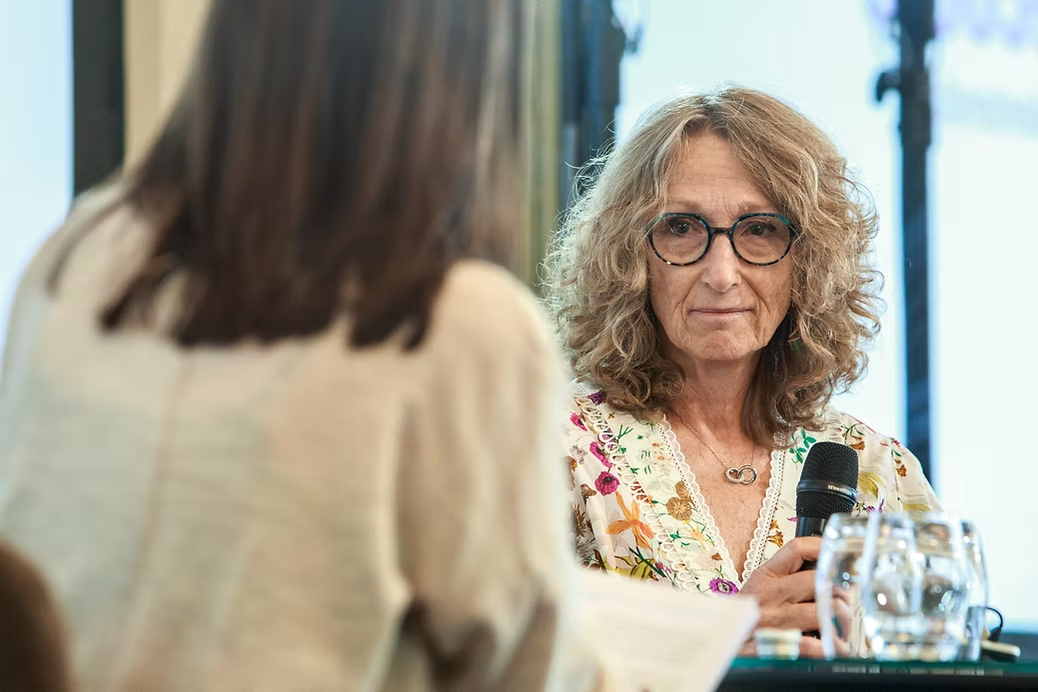
Photo © Sébastien Monachon