
Auracast is a Bluetooth audio streaming technology that could be incorporated into future updates to the SIA 500 standard on hearing accessibility. More open and versatile than traditional systems, it enables high-quality sound to be transmitted directly to compatible hearing aids or headphones. Our foundation has embraced this innovation by purchasing equipment from 2025 onwards and conducting an initial trial during its annual conference.
For decades, the induction loop has been the main solution for audio transmission in public places for people with hearing impairments. While this system has been of immense benefit, its installation and maintenance costs have sometimes hindered its roll-out. Now, a new approach is emerging with Auracast, a Bluetooth audio streaming technology that opens up new possibilities in terms of accessibility, both for people with hearing impairments and for the general public.
The principle is both simple and visionary: a transmitter broadcasts a Bluetooth audio stream that any compatible receiver can pick up instantly, without the need for complicated pairing. This means that an unlimited number of people can receive clear, direct sound on their own device, whether it be hearing aids or standard off-the-shelf earphones.
Technology available to everyone
This is where Auracast’s strength lies. Unlike systems reserved solely for users of specific hearing aids, this technology also works with standard headphones and earphones. This versatility is a game-changer for managers of museums, railway stations, conference halls and other public venues: choosing Auracast means catering to both people with hearing impairments and the general public, whether for improved sound quality or to access services such as audio guides or simultaneous translation. The investment thus becomes cross-functional.
Furthermore, for people with mild hearing loss who do not yet wear hearing aids, Auracast offers a first step towards accessibility without stigma.
At the forefront of testing and ensuring others are tested
In 2025, our foundation acquired Auracast transmission and reception equipment. The aim is twofold: to test the reliability of this technology and to enable people with hearing impairments to try it out for themselves so that they can form their own opinions.
Our approach also forms part of a changing legislative landscape, with the revision of the SIA 500 standard ‘Barrier-free Buildings’. All the signs suggest that Auracast will soon become an acceptable, or even recommended, solution for meeting accessibility requirements in buildings open to the public, where the current text refers primarily to induction loops. By anticipating this development, we aim to enable people with hearing impairments to familiarise themselves with the digital audio transmission systems that will be of use to them in the near future.
Feedback: our annual conference as a testing ground
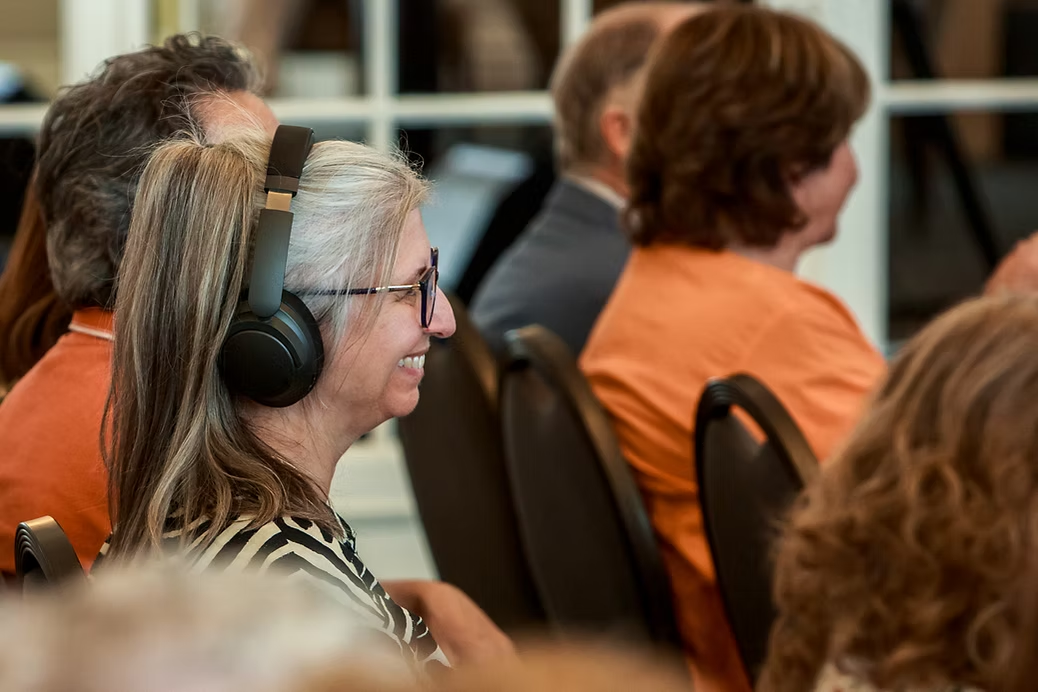
At our last annual conference, we gave three participants with hearing impairments the opportunity to test the Auracast equipment in a real-life setting. The aim was to assess how easy it was to connect to the equipment, the sound quality and how comfortable it was to use.
The feedback on how easy it was to get started is encouraging. While Sandra, the youngest, managed to log in straight away on her own, Marlène and Michèle needed a little guidance. However, they all agree that just a few explanations were enough to dispel their initial doubts.
Marlène and Sandra’s feedback on the audio quality was enthusiastic. They described the sound as ‘excellent’ and the volume as ‘just right’, enabling them to understand the speeches ‘much better’, without any cuts or interruptions. Michelle, on the other hand, found the quality to be “average” and felt the volume control could be improved. The hearing aid specialist in charge of overseeing this trial explains that these differences are not inherent to Auracast technology, but are due to the nature of a one-off test: fine-tuning and monitoring of the fitting could not be carried out with the same precision as for a conventional individual hearing aid fitting.
Despite these points to bear in mind, the overall sentiment remains positive. Marlène “absolutely” recommends Auracast and is “eager to be able to activate Auracast wherever there is an audience”. Michelle, despite feeling somewhat disappointed, appreciated the initiative: “I encourage you to try again,” she concluded. An invitation we shall accept without hesitation.
Feedback from this experience certainly confirms Auracast’s potential and demonstrates the willingness of people with hearing impairments to explore new solutions.
💡 We’ll be back regularly with further updates on the digital innovations that will improve hearing accessibility in the future. To make sure you don’t miss any of our articles: subscribe to our newsletter!
Photo: During the conference, participants also tried out headsets featuring Auracast technology, which can be used by both people with hearing impairments and those with normal hearing. © Sebastien Monachon